Neuro Sharp™
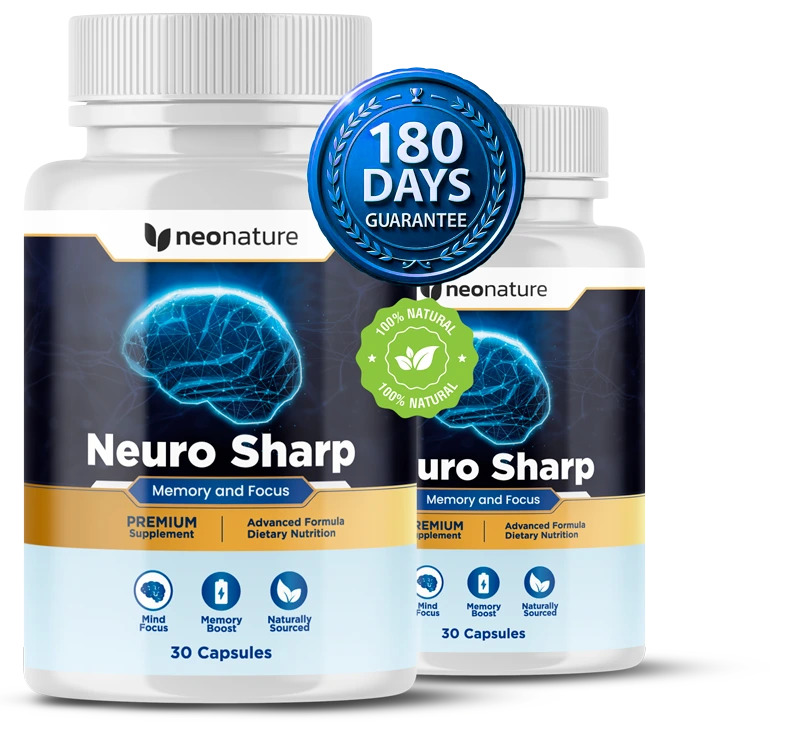
Memory & Focus
Focus, Attention & Mental Clarity
Cognitive Aging / Neuroprotection Support
Stress Resilience & Mental Energy
Potential Sleep / Recovery Support
ORDER NOW $49
Neuro Sharp is marketed as a brain-health or cognitive enhancement supplement (i.e., a “nootropic”) whose aim is to support memory, focus, mental clarity, and protect against age-related cognitive decline. On its website the manufacturer states it is:
- Made in the USA (in a GMP-certified facility).
- Formulated with “natural” herbal extracts, vitamins, and nutrients claimed to support brain blood-flow, neurotransmitter activity, mitochondrial energy, antioxidant protection.
- Intended for a broad audience (students, professionals, older adults) who wish to improve mental performance or stave off cognitive decline.
- Marketed with a “money back guarantee” (e.g., 180-day guarantee) in some versions of their website.
So in short: Neuro Sharp is one of many brain-support supplements offered online, positing that its blend of ingredients can enhance focus and memory and protect brain health.
2. Key Ingredients and Claimed Mechanisms
According to the manufacturer’s info, Neuro Sharp contains several types of ingredients; let’s review the commonly listed ones and what research (if any) supports them. Keep in mind: the exact ingredient amounts (dosages) are often not clearly disclosed in these marketing pages, which is a limitation.
2.1 Commonly Listed Ingredients
Here are some of the ingredients that appear in the product descriptions:
- Bacopa monnieri (an Ayurvedic herb) — claimed to enhance memory, learning, reduce “brain fog”.
- Ginkgo biloba extract — claimed to boost cerebral blood flow, nutrient/oxygen delivery to the brain.
- Phosphatidylserine — a phospholipid component of brain-cell membranes, claimed to enhance neuron communication.
- Huperzine A — a natural extract (from Chinese club moss) purported to inhibit breakdown of acetylcholine (a key neurotransmitter).
- Alpha‑Lipoic Acid (ALA) — a potent antioxidant, claimed to protect brain cells from oxidative damage.
- N‑Acetyl L‑Carnitine (ALCAR) — supports mitochondrial energy production in brain cells.
- L‑Theanine and Rhodiola rosea — adaptogens/ calming compounds, claimed to support focus under stress, reduce mental fatigue.
- Vitamin B complex (B6, B9, B12) — claimed to support neurotransmitter production, mood, brain energy.
2.2 Claimed Mechanisms of Action
The marketing claims highlight several mechanisms through which the product is said to work:
- Improving cerebral blood flow and oxygen/nutrient delivery (via Ginkgo biloba) to neurons.
- Enhancing neurotransmitter activity (e.g., acetylcholine, dopamine) to support memory, learning, focus.
- Protecting brain cells from oxidative stress and inflammation (via ALA, adaptogens) which are implicated in cognitive aging.
- Boosting energy in brain cells (mitochondrial support via ALCAR, B-vitamins) to reduce mental fatigue.
- Promoting calm focus and stress resilience (via L-Theanine, Rhodiola) to support sustained attention and clearer thinking even under pressure.
2.3 What the Research Really Says (at a Glance)
It’s worth noting what science supports and what remains speculative. Below is a summary, not exhaustive.
- Bacopa monnieri: There is some clinical evidence that Bacopa may improve memory and cognitive performance in older adults and in people under stress; but the effect size is modest, and high-quality trials are fewer.
- Ginkgo biloba: Some older studies suggest improved cognitive function (especially in older adults) and improved blood flow; but results are mixed, and effects in healthy younger adults are less consistent.
- Phosphatidylserine: Some evidence suggests modest benefits in cognition in older adults or those with mild cognitive impairment, but again, results are not dramatic and dosages matter.
- Huperzine A: Some studies show improved memory and cognitive performance in Alzheimer’s disease and healthy subjects; but dosage control, safety and long-term effects require more research.
- ALA, ALCAR, adaptogens: There is preliminary research on mitochondrial support, antioxidants and stress reduction as beneficial for brain health — but translating that into “big cognitive gains” in healthy people is still uncertain.
In short: Many of the individual ingredients do have scientific research backing cognitive or brain-health support, but combining them in a specific formula, dosages matter, and there is variability in how much benefit is obtained (especially for healthy individuals). Also, supplementation is complementary, not a guaranteed “boost” or remedy.
CLICK HERE TO BUY NEURO SHARP™
3. Potential Benefits
Based on the marketing claims + existing evidence for some ingredients, here are the potential benefits a user might hope for when using Neuro Sharp — along with caveats.
3.1 Memory & Recall
The product claims that users will “remember names, dates, tasks” more easily, reduce “brain fog” and support both short-term and long-term memory. For persons experiencing mild cognitive fatigue, stress-related memory issues or early age-related decline, a formula like this may help modestly. The presence of Bacopa, Huperzine A, phosphatidylserine are aligned with that goal.
3.2 Focus, Attention & Mental Clarity
The combination of brain-blood-flow herbals + adaptogens + mitochondrial energy support is marketed as enhancing focus, reducing distractions, clearing mental fatigue. For someone working under heavy cognitive load, this might yield subjective improvements (especially if baseline brain fatigue or stress was present).
3.3 Cognitive Aging / Neuroprotection Support
A major claim is protection against “age-related cognitive decline” via antioxidants, mitochondrial support, and improved circulation. While true neurodegenerative disease prevention is beyond any simple supplement claim, supporting brain-health habits + perhaps such supplementation may contribute modestly to long-term wellness.
3.4 Stress Resilience & Mental Energy
In many descriptions Neuro Sharp emphasises that the mind remains calm yet alert, as opposed to jittery stimulant-type support. Ingredients like L-Theanine, Rhodiola support this claim. If stress or mental fatigue are limiting cognitive performance, this could be beneficial.
3.5 Potential Sleep / Recovery Support
Some versions of their website mention improved quality of sleep and recovery of mental energy (via calm focus + mitochondrial support). Good sleep itself supports cognition, so indirectly this is a helpful support.
4. Limitations & Risks
It’s important to balance the possible benefits with limitations, uncertainties and risks.
4.1 Lack of Transparent Dosage & Independent Trials
- The public marketing pages do not clearly disclose full dosages for each ingredient (or at least they are not easily found). Without knowing dosage, it’s hard to judge how “effective” the formula is relative to clinical studies.
- The formula appears to be proprietary, so we don’t always know which ingredients are in what proportion.
- While many ingredients have research, there is a lack of large independent clinical trials specifically on the Neuro Sharp product itself (i.e., “this exact formula at this dosage in this population”) publicly available.
4.2 Regulatory & Health Claims Caveats
- Although it’s made in GMP-certified facilities, supplements do not require the same rigorous FDA approval as prescription drugs for efficacy. Often they are regulated as dietary supplements.
- Some websites for Neuro Sharp state “FDA Approved” or “FDA Registered Facility” — but that does not mean the supplement itself has been clinically evaluated or approved as a drug. Users must interpret such claims carefully.
4.3 Effect Variability & Realistic Expectations
- If a person is already healthy, well-rested, well-nourished, with normal cognition, the “boost” they may obtain from such supplement could be modest (and not dramatic).
- Many of the effects (memory support, focus) depend on baseline conditions (ageing, fatigue, stress, poor sleep, etc). A supplement cannot substitute for foundational aspects like good sleep, nutrition, exercise, mental challenge.
4.4 Interactions and Contra-indications
- Some of the ingredients (e.g., Huperzine A, Ginkgo biloba, St. John’s Wort in some versions) may interact with medications (anticoagulants, antidepressants, other cognitive drugs) or have contraindications.
- Adaptogens and herbs are generally well-tolerated but not without potential side-effects (GI upset, sleep disruption if taken late, etc).
- ALWAYS advisable to consult physician if you are pregnant, on other medications, have neurological conditions or serious health issues.
4.5 Marketing / Pricing Considerations
- The price (~$49 USD for a bottle according to some pages) and “limited-time” discount style suggest this is marketed as a premium supplement. For Indian users (in INR) or outside US, import shipping/costs might add up or availability may vary.
- Some reviewers note caution with buying from “non-official” sources to avoid counterfeit or diluted product.
CLICK HERE TO BUY NEURO SHARP™
5. Practical Advice: How to Use (If You Decide)
If you are considering trying Neuro Sharp, here are practical suggestions to maximize potential benefit and minimise risk:
5.1 Before You Start
- Consult your healthcare professional, especially if you are on medications, have health conditions (especially brain-/nerve-/cardiovascular related), are pregnant/lactating, or plan other supplements.
- Assess your baseline lifestyle: sleep quality, nutrition, exercise, stress levels, cognitive load. Supplements work best when these foundational factors are addressed.
5.2 Dosage & Timing
- The website suggests “take one capsule daily” (usually a single serving) with a glass of water, often with a meal.
- For maximal effect, take it at the same time each day (for example morning with breakfast) so your body adapts and you avoid late-day stimulation issues (if any adaptogens are stimulatory).
- Track your experience for at least 4-6 weeks, because many herbal/nootropic effects build gradually (not instantaneous). Some websites say 2-3 weeks for focus improvements, 4-6 weeks for memory.
5.3 Combine with Good Brain Habits
- Adequate sleep (7-9 h where possible) is crucial for memory consolidation and cognitive performance.
- Balanced nutrition (including adequate protein, healthy fats — especially omega-3 fatty acids, vegetables, antioxidants).
- Regular physical exercise (key for brain health, blood flow, mitochondrial support).
- Cognitive engagement (learning new skills, mental challenge, variety).
- Stress management (meditation, breaks, positive lifestyle).
- Hydration and limiting excessive alcohol/other substances that impair cognition.
5.4 Monitor Results & Side-Effects
- Keep a journal to note focus, memory, mental clarity, energy, mood, sleep, over the first 1–3 months.
- Look out for any side-effects: e.g., agitation, insomnia, GI upset, headache, bleeding tendencies (with Ginkgo), interactions with meds.
- If you notice any adverse reaction, stop use and consult your provider.
5.5 Evaluate Cost–Benefit
- After 90–180 days, evaluate whether the supplement appears to provide noticeable benefit (versus placebo effect or natural variation).
- Consider whether continuation makes sense in your budget and health-strategy.
CLICK HERE TO BUY NEURO SHARP™
7. Final Thoughts: Is Neuro Sharp Worth It?
In summary:
- If you are experiencing mild cognitive fatigue, brain-fog, focus issues (not due to a diagnosed medical condition or drug side-effects), and you already maintain decent lifestyle habits, a supplement such as Neuro Sharp may provide modest additional support.
- If you are young, healthy, well-rested, properly nourished, and already cognitively sharp, the incremental benefit may be small. The “boost” experienced might be subtle and may also reflect placebo effect or improved sleep/ habits rather than the supplement alone.
- The product does appear to be reasonably legitimate (manufactured in GMP certified facility, clear marketing, money-back guarantee) — though the lack of fully transparent dosage and independent large clinical trials specific to the formula means one should have realistic expectations.
- Use cost-effectiveness judgment: if you pay a premium, you should monitor results and be willing to stop if benefit is minimal.
- Always pair such supplementation with foundational brain-health habits (sleep, nutrition, exercise, stress control) — the supplement is best thought of as adjunctive, not a substitute.